
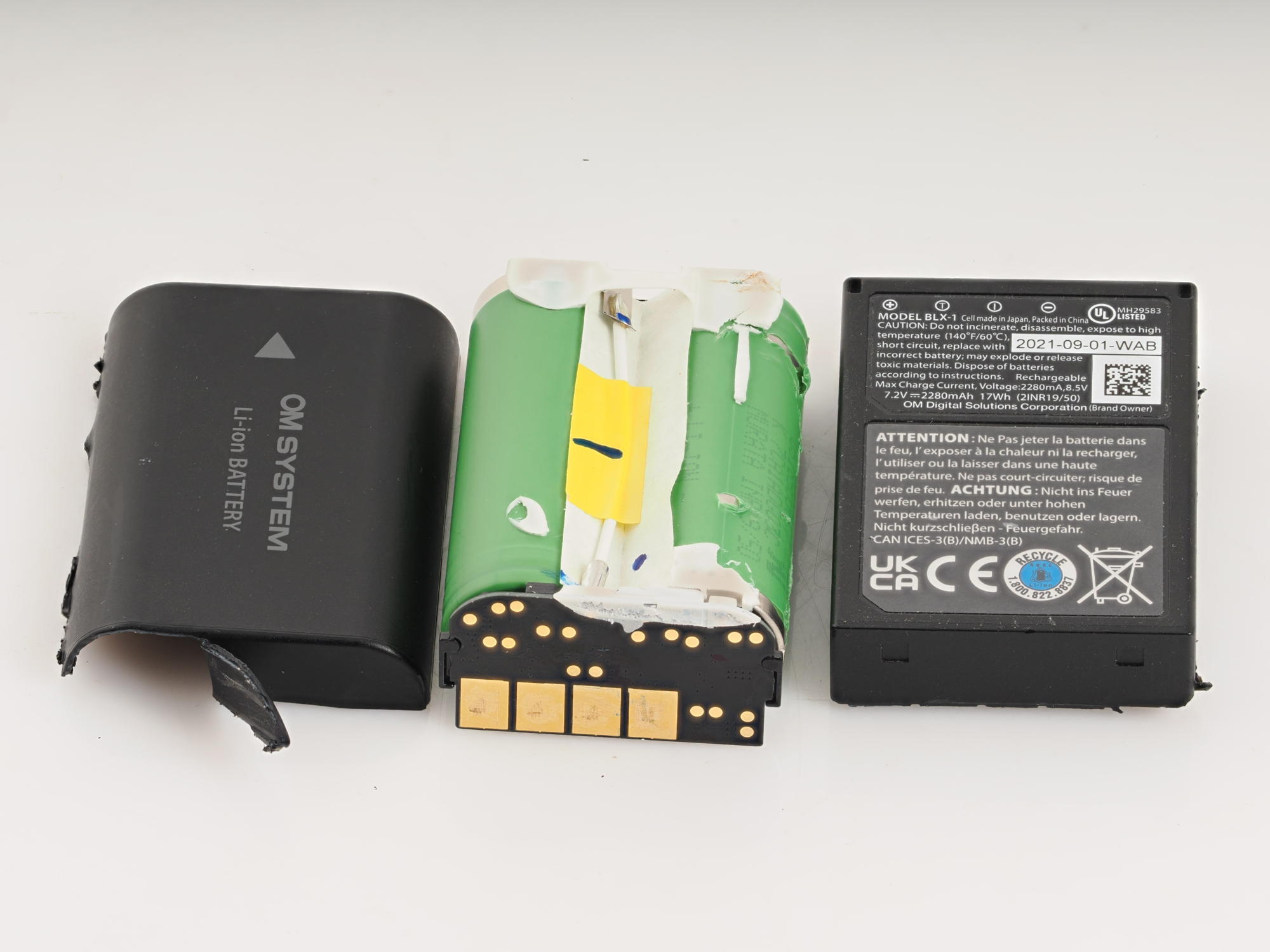
As I mentioned during the last PATLIve, I’ve taken apart my first original BLX-1. The battery was dead – it wouldn’t charge and read 0.00 volts. So I took it apart.
All it took was a small screwdriver and about two minutes. Then it was open. Open one side, pry it open. Done.
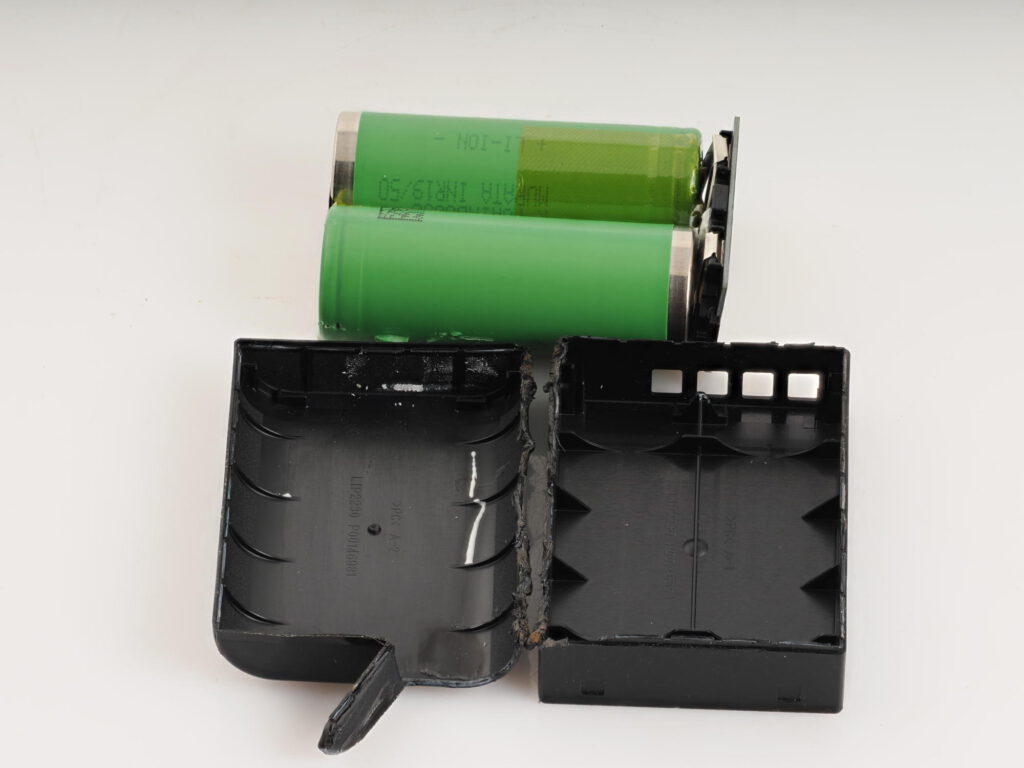
The casing is made of really thin plastic and the side panel of the outer shell has broken off on its own. Quality rating: cheap Chinese clone. A few drops of a hard adhesive were supposed to hold the batteries in place inside the casing, but as you can see, it didn’t stick to the casing material. The build quality is rock bottom.
The cells are from Murata. That’s Tohoku Murata Manufacturing Co. Ltd in Fukushima, which bought Sony’s lithium-ion production business ten years ago. As stated on the outside, the cells are ‘Made in Japan’, manufactured in China. After removal, the cells measured 0.23 V and 0.48 V. Apparently, the electronics classified the cells as faulty and shut them down. The battery is from 2021, so it’s rather unlikely that both cells are dead. Perhaps the electronics decided that they differed so greatly that load balancing was no longer possible. Who knows.
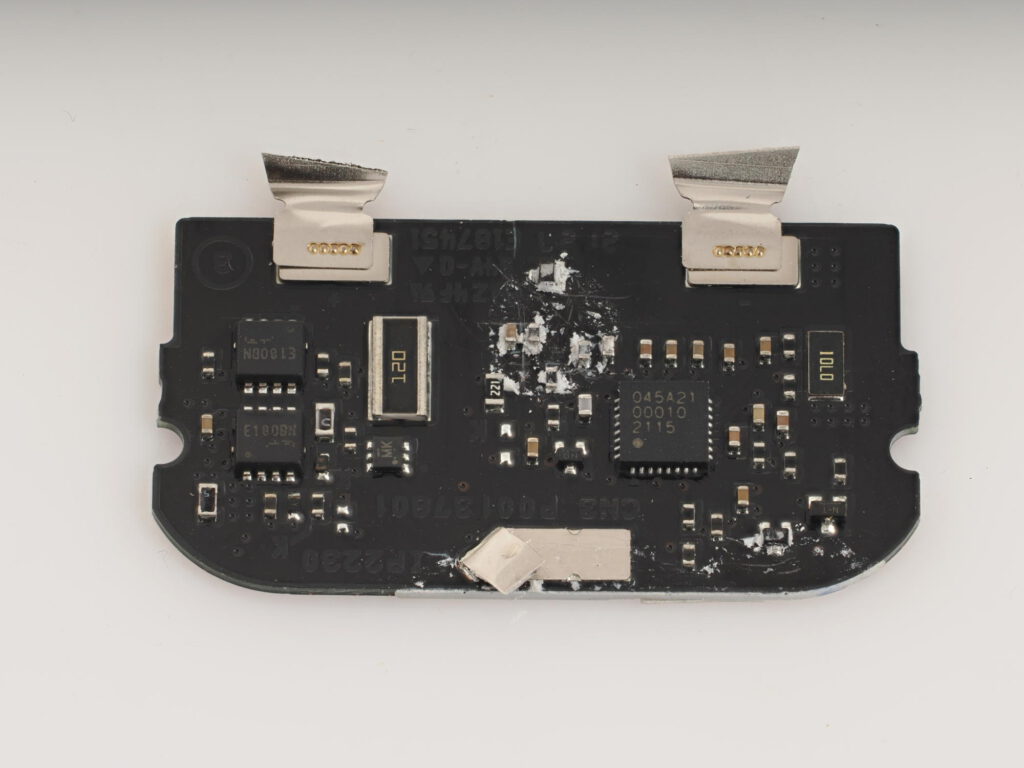
That’s the circuit board. So, if you can identify the chips, have fun – I couldn’t be bothered.
Now it’s getting interesting. These days, there aren’t just the Patona Platinum or the Jupio BLX-1 clones, but also a clone from ‘Powersmart’. It looks like this:
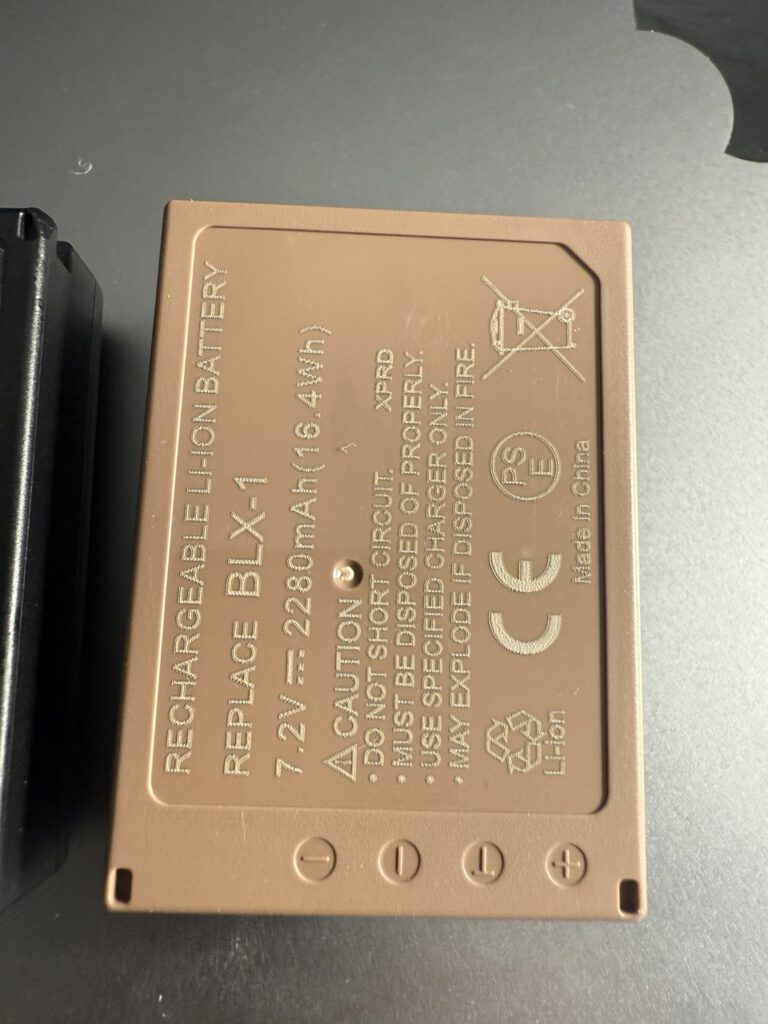
Brown. The model is DOY022-240. It’s sold via Otto, MediaMarkt, eBay or Akkugigant.de, who are asking 17.99 for it. USB port. And, of course, a charging indicator light.
We’ve now put this battery up against the original BLX-1. Both batteries were brand new. The results: consistently, the ‘Powersmart’ lasted longer – by about 3 per cent. That’s not a huge difference, but it’s suspicious. So we hooked up a meter and found that the original battery reached a capacity of 2162 mAh, whilst the clone reached 2312 mAh. That’s a 6 per cent difference. Clearly, the ‘brown’ one has greater endurance. It’s also 3 grams heavier and has a casing that feels more solid to the touch.
According to an expert, the cells inside are said to be from Vietnam – either from CATL or Sunwoda. CATL is the world’s largest battery manufacturer, whilst Sunwoda ranks sixth. Apple has invested in the latter company, and Tesla now uses Sunwoda batteries. (And yes, although the companies are Chinese, they also have factories in Vietnam.)
These are thermal images of the original (left) and the clone (right). You can see the USB port on the clone. And you can see that the battery remains significantly cooler after charging.
Of course, you can’t see how the battery is constructed on the inside. The battery is fine, and destroying it just to find out whether there’s glue inside or not is a waste of resources. But there can’t be less than nothing inside, and nothing rattles around in the battery either.
As cheap as the ‘brown’ one looks – it’s not only more practical, but obviously better too.
And it costs less than a quarter of the price of the original.
Danke, dass Du für uns die Akkus zerlegst oder mindesten von außen unter die Lupe nimmst. Dass der “braune” sein Geld mehr als wert ist, ist auch interessant!
Anmerkung:
Ein Ei ist solange gut, bis es verkauft ist.
Alte afrikanische Weisheit.
Danke für die “Bewertung”!
Lassen sich die Akku-Clone mit USB-Port auch (bedenkenlos) in der Kamera aufladen? Ich habe selber den Patona, finde aber weder für diesen noch für den Powersmart eindeutige Angaben der jeweiligen Hersteller. Ich vermeide es deshalb bisher eigentlich, den Patona in der OM-1 zu laden, allerdings passierte es mir schonmal versehentlich, da schien er zu laden, bis ich es merkte. Ein ungutes Gefühl blieb aber.
Es gibt da eigentlich keine Hinweise, dass das ein Problem geben könnte. Beim BLX-1 ist es extrem unwahrscheinlich, dass er sich aufbläht, also kann da nix schiegehen.
Danke für die Infos, gut zu wissen das es gute Alternativen zum Original gibt, auch wenn meine beiden BLX-1en aus 2022 und 2023 noch klaglos funktionieren, genauso wie meine 4 BLH-1en von 2027/18 zu den EM-1sen und selbst der PS-BLS1 von 2011 für mein EP-1 funktioniert noch recht gut. Nur die Akkus zu E-3 lassen deutlich nach, wobei der Pantona tut es auch noch einigermaßen.
Haben beim Powersmart die Kontakte alle die gewünschte Funktion? Da war doch was mit Temperatursensor.
Zumindest Media Markt und Otto sind nur Marktplatz für den Händler akkugigant.
Der NTC ist bestückt und funktioniert.
Die I-Schnittstelle funktioniert auch.