
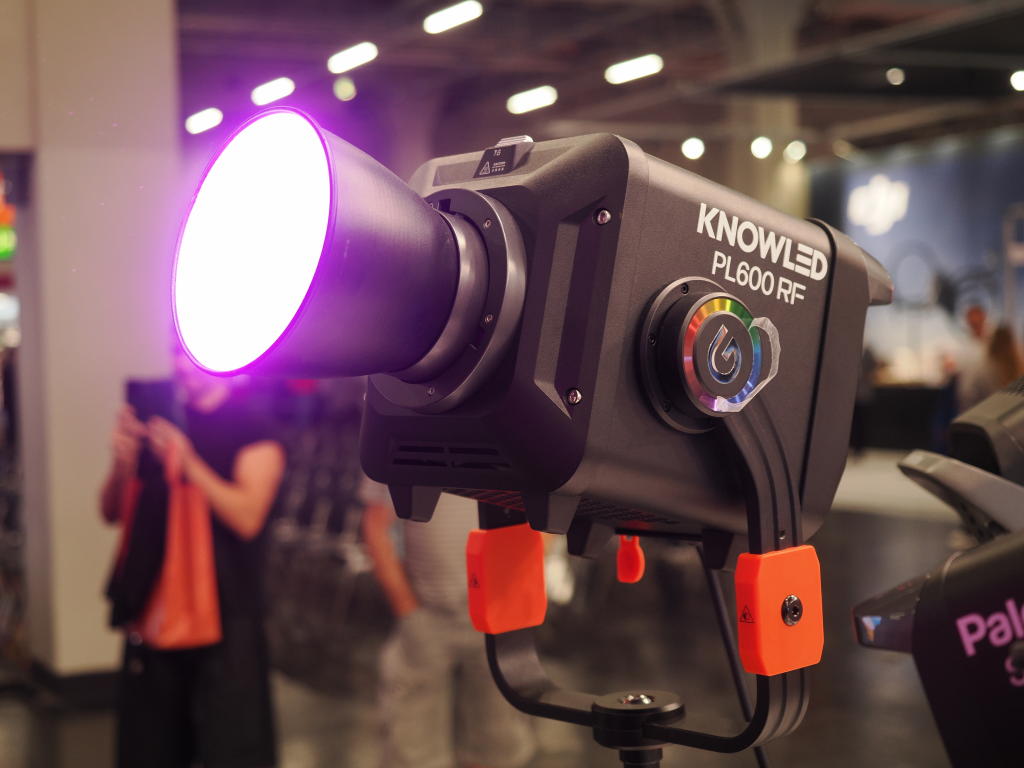
I did, after all, say in my books at the start that LEDs were no good. Then I said that LEDs require huge LED panels and that there are no decent light modifiers for them. And now I’ve been to Imaging World and seen LED spotlights with outputs of up to 2.4 kW. With a perfectly standard Bowens bayonet mount for light modifiers fitted at the front. With colour control and all those colour effects – fire simulation, thunderstorm simulation, emergency lights simulation.
Even the ‘small’ 600-watt LEDs make your hands feel warm when you hold them in front of them. The 600-watt ‘grill’ from Godox costs around 2,200 euros on the high street.
Patona now has these as well, in green. 100-watt: 179 Euro, 200-watt: 199, 300-watt: 249, and 600-watt: 899.
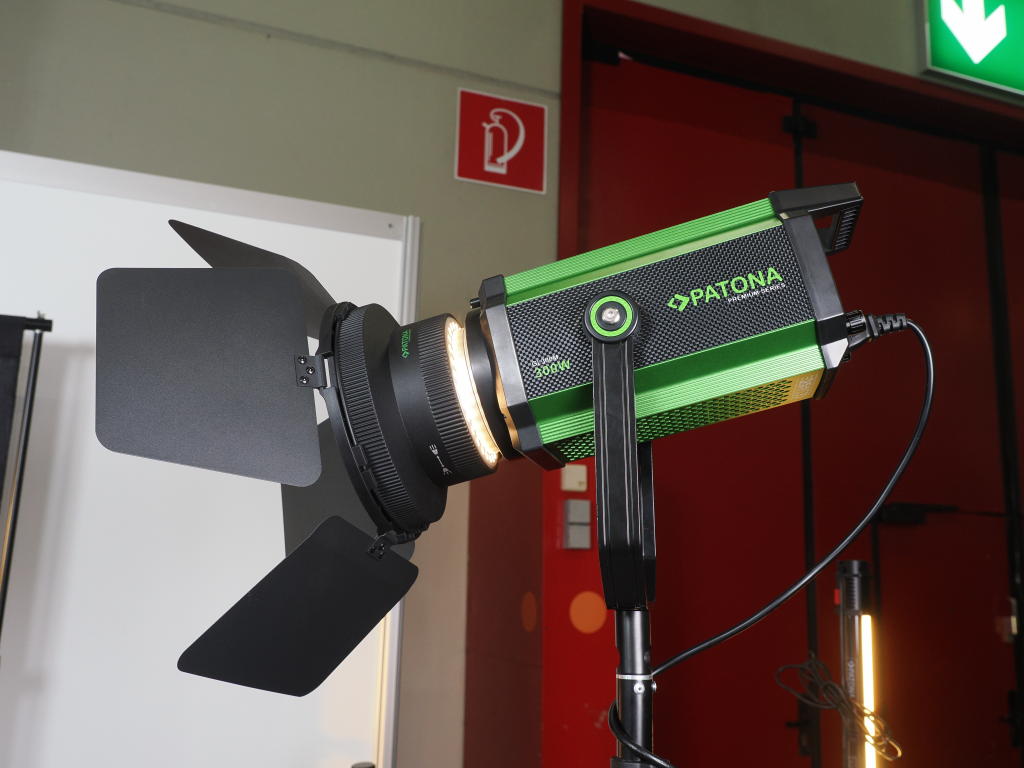
And 1,200 watts too – I didn’t even ask about the price.
What are we to make of this?
The luminance is brutal. If you accidentally look into one of those 600-watt lights, coloured circles dance before your eyes for minutes on end. When it comes to photographing fast movements with short exposure times and high continuous shooting rates, these lights are absolutely brilliant. Or for workshops where everyone wants to take photos at the same time. (The fact that I’m not keen on that – because only one person ever has the good angle and everyone else misses out – is another matter entirely.)
For photography in a small studio, three or four 200-watt spotlights would be enough for everything; if you use snoots, then perhaps two 300-watt ones as well. That means you can set up a complete continuous-light studio for 900 euros. That’s pretty impressive.
Who would still want to use flashes then? You’d need radio triggers. You’d have to factor in flash recycling times. Synchronisation times. You’ll have problems with exposure metering and, under certain circumstances, even with white balance. With an electronic viewfinder, you’ll need viewfinder illumination, and high-resolution shots become a problem.
So, should you get rid of the flashes and buy LEDs instead?
The flashes still have a few advantages: they’re far more energy-efficient. They don’t need 400 watts all the time – just when they’re firing. They don’t generate nearly as much heat in the studio. Because even though LEDs are more energy-efficient than incandescent bulbs, the 600 watts are converted entirely into heat. And with 1.2 kilowatts of light in the studio, I’ve got the equivalent of a fan heater.
And, probably the biggest problem: nobody wants to look into this light for any length of time. LED lighting is unsuitable for portrait photography.
Hast du Infos, wie das Spektrum der Strahler aussieht? Gut genug, dass man es mit einem Weißabgleich in den Griff bekommt?
Patona: CRI >95.
Die Zeiten, in denen die Foto-LEDs mit Müh und Not einen CRI von 80 erreicht haben, sind glücklicherweise vorbei.
Die Godox (Knowled) Palette Lab sind natürlich eine Liga drüber. CRI>98, und TM-30Rf 97 und TM-30Rg 103. TLCI 99. Kosten halt auch das dreifache. (Patona hat natürlich, darauf angesprochen, nicht auf die andere Farbwiedergabe verwiesen, sondern darauf, dass man bei Godox den Markennamen bezahlen würde.)
Für den Hobbyisten sind die Patona ausreichend. Für den Profi müssen es die PaletteLab sein.
Ach ja: die Godoxe sind IP 65.
In der Veranstaltungsbranche verwenden wir mittlerweile fast ausschliesslich LED Scheinwerfer. Halogen und Entladungslampen sterben langsam aber sicher aus. Sogar Stroboskoplicht wird heutzutage fast ausschliesslich mit LED produziert.
Die letzte Bastion war klassisches „Weisslicht“ im Fernsehstudio/Theater usw und auch da gibt es ein „Halogensterben“. Die grossen Hersteller wie z.B. Arri haben längst LED Lampen mit hohem CRI und schönen Dimmerkurven. Mittlerweile kann man sogar echt gut auf Knopfdruck die Farbänderungen einer Halogenlampe beim Dimmen reproduzieren.
Ich denke viele Fotodauerlichtlampen sind entwicklungstechnische „Abfallprodukte“ aus der Eventindustrie, also kann man durchaus hohe Qualität erwarten.
Aber für bestimmte Dinge würde ich immer Blitze verwenden. Portrait ist so eine Sache und z.B. unter Wasser fotografieren. Da bin ich nach wie vor absoluter Fan von starken Ringblitzen, auch starke Videolampen können da nicht mithalten und dann noch der Stromverbrauch: mit einer Akkuladung macht mein Unterwasserblitz locker 1200 Blitze. Das reicht locker für 3-4 Tauchgänge à >60Min, je nach Anzahl Bilder/Motive. Der gleiche Akku macht knapp 40-60 Min an einer starken Videolampe.
Auch die Monochromen PAR-LED-Lampen von vor zehn Jahren sehe ich kaum noch. Was mittlerweile auf den Bühnen steht, ist absolut brauchbar.
Ohja!