
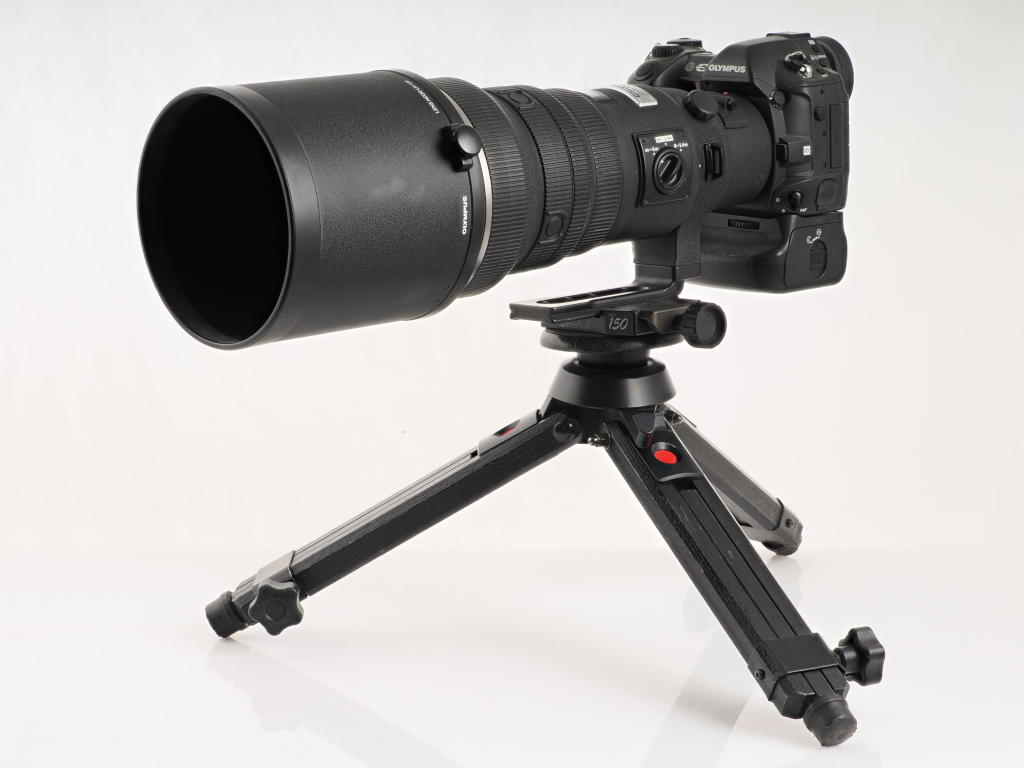
Sometimes you feel as though you’re trapped in a time loop. You shouldn’t throw clothes away – they’ll come back into fashion at some point. One such recurring theme is the story of improved autofocus thanks to a different battery. The story first emerged in the Olympus community back in 2004. When the pros attached the large FT lenses to an E-1 with a battery grip and realised – wow, that’s quicker.
The reason was simple. The E-1’s battery grip didn’t just contain another BLM-1, but a proper BLL-1 – a battery with a capacity of 3400 mAh. The large FT lenses have big stepper motors inside to move the massive focus rings. These required power, and the BLL-1 could supply it more effectively than the smaller BLM-1. And just like that – the AF was faster.
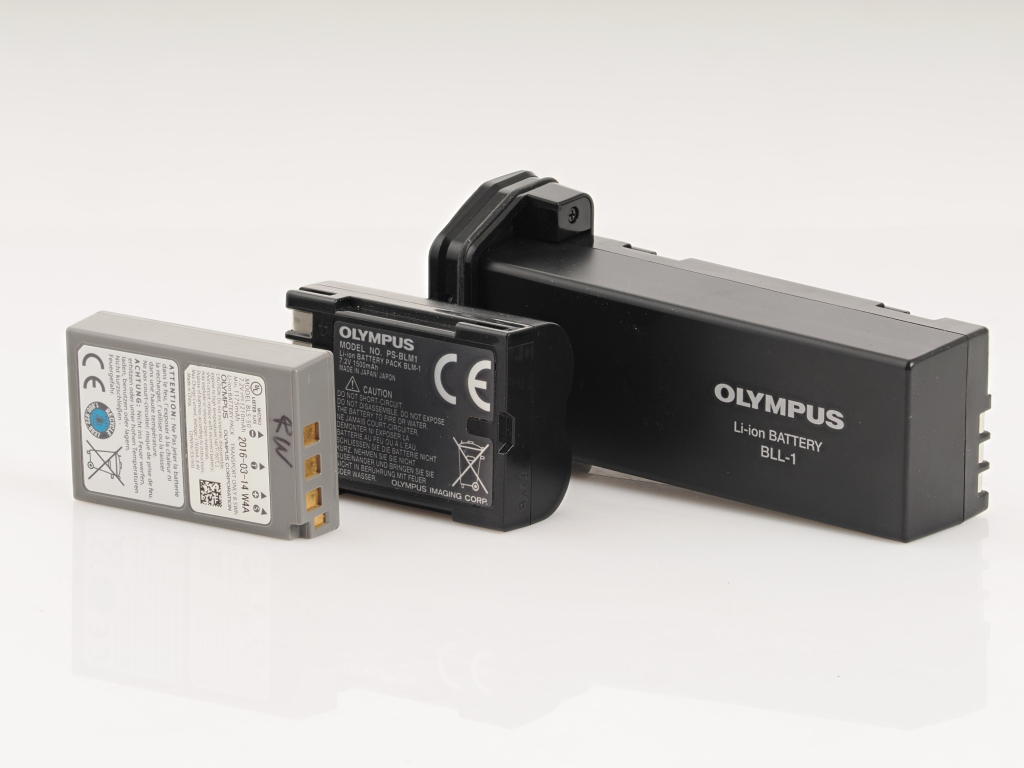
Here’s a size comparison. BLS-50 1210 mAh, BLM-1 1500 mAh and BLL-1 3400 mAh.
FTs still pose a challenge for batteries, as large masses have to be accelerated extremely rapidly.
MFT has it easier in this respect. MFT lenses have smaller focusing elements, and with contrast AF, the lens doesn’t need to be brought up to high final speeds. That’s another reason why you can get so far with a comparatively tiny battery on MFT.
Now, someone has actually come up with the brilliant idea of simply giving a ten-year-old processor a higher voltage, so that it suddenly works faster. Blimey – faster autofocus. Why on earth haven’t all those engineers thought of this ages ago? On the contrary, they’ve been using ever lower voltages to power their processors…
In fact, the BLS-7 is specified as having a nominal voltage of 7.74 volts. (This corresponds to a cell voltage of 3.87 volts.) The BLN-1 had a rated voltage of 7.6 volts, the BLS-50 7.2 volts and the BLH-1 7.4 volts. What can we conclude from this? With the E-M5, they boosted the processor’s speed, but with the E-M10, OM-5 and the whole PL range, they decided – they’re fast enough, so there’s no need for that. And the E-M1II, which has the same processor as the ‘PEN’, doesn’t need a speed boost either.
As you can see, the argument is compelling.
The BLS-7 is a battery manufactured entirely in China by Highpowertech for OMDS. This isn’t some backstreet operation, but a listed public limited company. Just as an aside.
So: the battery’s brilliant – but does that make the processor faster? No. For the same processor to run faster, it needs to be clocked at a higher frequency. And as any modder knows – that requires more cooling. However, the PEN has a plastic body, which is generally not ideal for cooling. And in all other respects, the PEN is by no means a speed champion. So why, of all things, is it so good at AF?
What actually influences the speed of the autofocus:
- The focus motor in the lens. The speed and power of the motor in relation to the weight of the focus mechanism.
- The sensor’s readout frequency. The more frequently the sensor is read out, the better and faster the focus can be corrected.
- AF algorithm. The OM cameras have a tendency, when using AF, to defocus first before refocusing. The sensor apparently requires this for phase-detection AF. The E-M1II’s sensor does not need this. That is why the E-M1II’s AF is faster in certain situations where the AF is already very close to the target position. The OM-1, on the other hand, can initiate phase-detection AF more quickly because it processes phase-detection AF commands natively. The ‘delay’ caused by the defocusing depends on the firmware version.
There are also other factors that influence the perceived speed of the AF.
- Shutter release response. Both the shutter release button itself and a ‘tap’ on the display have a delay.
- Size of the focus area. With ‘all areas’ selected, the AF has no trouble finding something to focus on. The smaller the focus area, the slower the AF becomes, although it also becomes more precise.
- Accuracy. If you don’t set the AF to 100 per cent, but realise that 98 per cent is good enough, you can speed up the autofocus considerably. (The 12–200 is really sharp at the long end – you just don’t notice it because the manufacturer thought it didn’t matter so much there and gave the AF larger steps in that range.)
- Aperture. The wider the aperture and the longer the focal length, the more precise the autofocus needs to be. When I’m shooting at 12 mm and f/5.6, the focus distance hardly matters.
- And, of course, light and movement of the subject and/or the photographer, and even the colour and pattern of the subject. (The E-5 had extreme problems focusing on bright red dresses.)
- Oh, and by the way: when it comes to subject recognition, it now also depends on whether the subject in question has been trained into the system. Not every car is recognised as a car.
So: just because the battery now says 1285 mAh instead of 1210 mAh on the BLS-50, that doesn’t mean anything in the camera runs any faster.
I suspect the new battery was chosen because it contains round cells and the battery is charged inside the camera. After all, the old BLS-50 could easily be replaced by a 15-year-old BLS-1. And they’re now churning out fat ones by the dozen. If that happens in the old charging cradle, it’s no bother. If it happens inside the camera, then the camera’s due for a service. And I reckon that’s really got on the nerves of the people in Tokyo by now.
Hallo Reinhard,
in der neuen OM PEN ist laut Hersteller der Prozessor der E-M1 III und nicht II verbaut, auch wenn die sich nach Dir kaum unterscheiden.
In einem älteren Artikel hast Du mal geschrieben, dass die E-M1 II präziser fokussiert als die III und die X, da letztere auf mehr Geschwindigkeit getrimmt sind.
Das dürfte sich dann hier ähnlich verhalten, oder?
Gruß, Matthias
Das kommt auf die Firmware an. Die Firmware, die auf das 150-400 optimiert wurde, fokussiert mit den anderen Optiken schlechter. Umgekehrt fokussieren E-M1X und E-M1III mit dem 150-400 besser als die E-M1II. Die beiden Prozessoren 8 und 9 sind bis auf den Cache meines Wissens identisch. Die X hat einen 8, die III einen 9. (der zweite 8 der X ist nur für die Objekterkennung.) Die Fokusgeschwindigkeit hängt bei diesen P?rozessoren von der Firmware ab. Es kann durchaus sein, dass die PEN mit bestimmten Objektiven in bestimmten Situationen superschnell fokussiert. Das hat aber nichts mit dem Prozessor oder dem Akku zu tun, sondern mit der Firmware. Da ich die Kamera nicht habe, kann ich das nicht erforschen.
Die OM-1 hat einen völlig anderen AF und den doppelten Readout. Und einen völlig anderen Prozessor.