
The discussion is currently in full swing in the comments section of a rumour site: has OMDS actually secretly fitted a new, more powerful processor into the PEN? Did Sony perhaps accidentally supply a processor that incorporates the fast AF found in Sony cameras? The reason for these speculations is Robin W’s video, in which he demonstrates that the autofocus at close range with the 60mm macro lens is faster than on the OM-1.
I’ve now pitted my OM-1 against my E-M1II – using the 30mm macro lens. Lo and behold – the E-M1II is faster at close range. How is that possible? The two cameras have different sensors with completely different AF philosophies. Depending on what you’re photographing, sometimes one AF system is faster, and sometimes the other.
Why haven’t I addressed this sooner? I’ve tested the AF performance in every book and with every firmware update. The cameras’ AF performance has changed – sometimes drastically – from one firmware version to the next. Some lenses performed faster with certain subjects, others slower. That’s why such a simplistic comparison – which readers always love – is rather silly. You can’t even say which firmware delivers the best AF on the OM-1. It depends on the subject and the lens you’re using. It’s impossible to specify exactly.
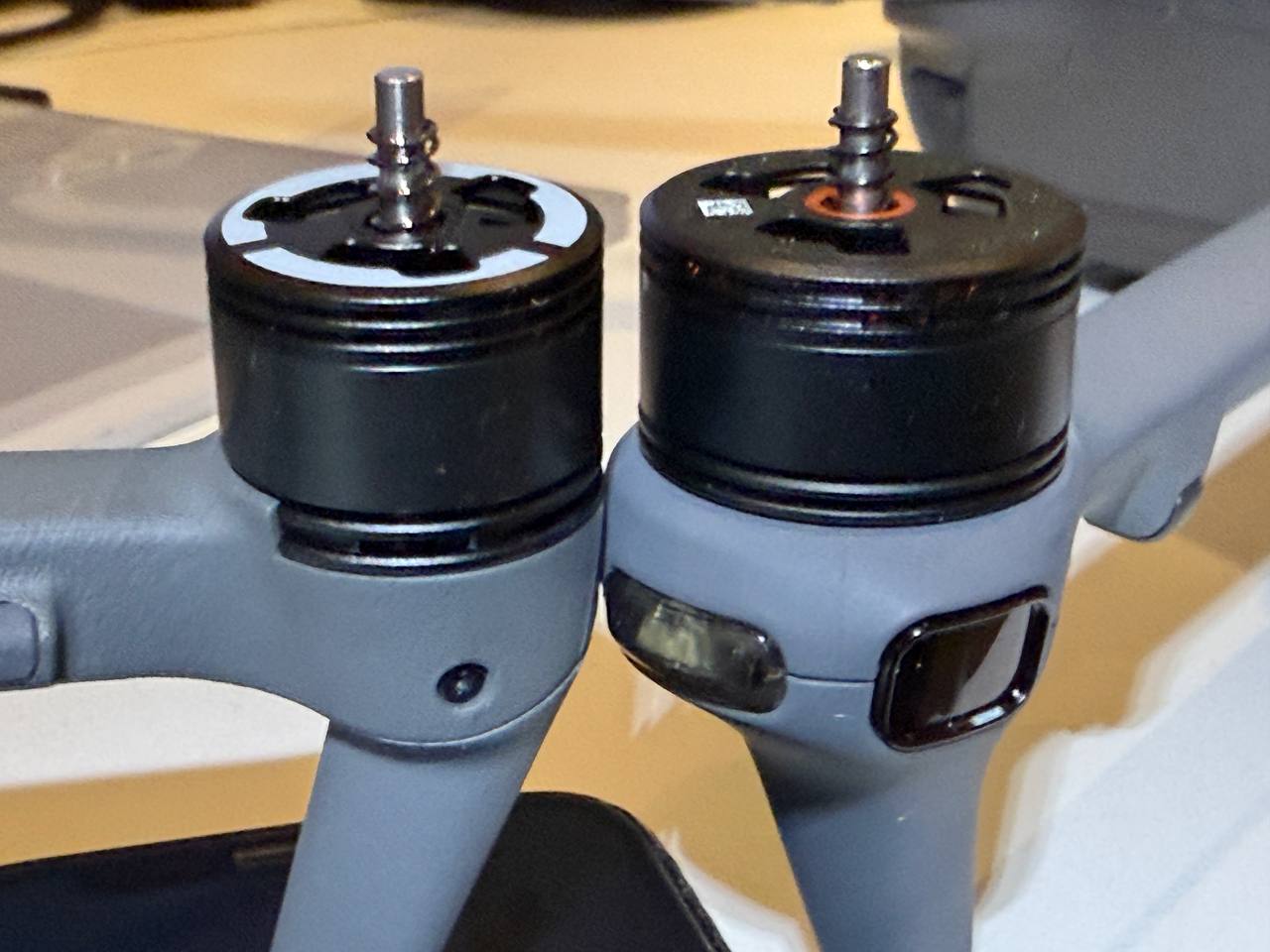
What everyone does notice immediately, however, when looking at the cover image, is that the two drone motors are different sizes. One arm belongs to a Mavic 3, the other to a Mavic 4.
So what? The difference isn’t that big, is it?
Appearances can be deceiving. Especially when it comes to the volume of cylinders. In fact, the new motor is 2.27 times larger than the old one. To draw a car analogy – a four-cylinder engine with a 1-litre displacement versus a four-cylinder engine with a 2.27-litre displacement. At the same price. With a vehicle weight of 1,150 kilos instead of 1,000 kilos.
So surely this thing should take off like a rocket? The official figures show rather moderate changes. Climb rate +25 per cent, horizontal speed +19 per cent, wind resistance unchanged at 12 m/s. So – “minor improvements”.
Is it even worth it? The motors contain special wires that don’t get as hot, new rotors 27 mm longer – which provides 25 per cent more rotor disc area – and a battery with 23.8 per cent more capacity but lower weight. (Which explains the 22 per cent longer hover time.) But surely all that’s rather marginal?
The increases in speed are interesting. To boost the climb rate from around 8 m/s to 10 m/s, you need about 40 per cent more climb performance, and the motor power has to be even higher.
And now it gets interesting. There’s actually a video from DJI:
This is already a year old and everyone’s probably seen it by now – 3.4 million views – but it’s always great to watch again – and here’s the Mavic 4 at almost 9,000 metres. An altitude at which many helicopters can no longer fly. You can see there’s a fair bit of wind up there – and the Mavic isn’t fazed in the slightest.
In fact, the Mavic seems to have considerable reserves that it can activate in an emergency. Why build this in and prevent the customer from accessing it normally? The reason is simple. The drone is designed to return when the ‘Fly Home’ function is activated. And if, foolishly, it’s been carried off by the wind whilst flying away, then it simply has to fly back against the wind. That’s when the ‘dormant power’ is activated and Spaceship Orion manages the ‘re-entry to Earth’. Why isn’t this communicated? Because otherwise the customer, relying on these reserves, might do something foolish.
The drone on Mount Qomolangma – known to us as ‘Everest’ – was a standard Mavic model. The only modification made was to remove the altitude limit. Oh, and it’s also completed a few other flights, namely delivering medicines to one of the higher camps. It’s just that nobody talks about that.
Would anyone actually claim that the Mavic 2 is better, faster or more impressive than the Mavic 4? Err… no. That’s what you call technical progress. Evolution. For some camera manufacturers, a drone with chrome-plated arms would already be a new model, and one with a particularly aerodynamic paint job would be a ‘revolution’.
We shouldn’t let ourselves be taken for a ride any longer.
Is the new product a thousand or even two thousand euros better than the old one? Then bring it on. Is it not? Then keep that rubbish.
PS: The Japanese publication EETimes took the two drones apart and found that all the chips are of a newer generation, the processors have more cores and – pretty much the only thing that has remained the same is the 48MP 1/1.3-inch sensor in the medium telephoto lens. The FT wide-angle sensor went from 20MP to 100MP, and the 1/2″ telephoto sensor went from 12MP to a 1/1.5″ 50MP sensor. The Mavic 3 was released in 2023, and the Mavic 4 in 2025.
PS2: The Everest bit isn’t really new, though – they’ve already done that with the Mavic 3.
Der Herr mit dem AF Video hat schon viel zu viel Aufmerksamkeit bekommen. Das ist auch der einzige Grund warum er so einen Quatsch behauptet, er weiß wie das influenza Game läuft.