I’m a journalist. I report the news. Yes, I have a very informal writing style and I don’t hold back when it comes to expressing my opinion on certain matters. And I’m a moralist. But I always try to keep my distance from the subject of my reporting. I don’t always succeed – I have a very special relationship with PEN-F, for example – but I do try.
I make fun of a company when it does silly things. I write about problems with its products. And personally, I like some of the people who work there less than others. But I don’t write, ‘That company is rubbish’. And when they do good things, I’m always ready to write that they’re doing good things.
That’s journalism. When I interview a candidate, I must also give the opposing candidate the opportunity to comment. The ‘I won’t talk to you because I don’t like you’ approach isn’t journalism, but propaganda. If the opposing candidate doesn’t want to talk to me, that’s not my problem, but his.
Now, if people who don’t like my reporting try to let off steam in the comments sections, I allow it, because they usually end up discrediting themselves in the process. What I moderate out are comments that are relevant under criminal law or simply blatant insults with no basis in reality.
Of course, it’s easier to take it out on the bearer of bad news than to confront the person who messed things up. As Cassandra already realised – though that didn’t end well for the people who refused to listen.
Unlike Cassandra, I can’t see into the future and I don’t have any divine ancestors either. More of a tradesman. A roofer. A master painter. That’s why I make mistakes too. Like recently with the ownership structures of Japanese battery companies. So I’m grateful for corrections. If someone knows something better, they’re not a know-it-all – they’re very welcome. And if anyone has something serious to say – feel free to come along and have your say on camera.
And – unlike all those wannabe political influencers and ‘podcasters’ who only invite people whose reach they can tap into – I’m happy to have people on the stool who nobody’s ever heard of. The main thing is that they’ve got something important to say. And I’ll reply, too.
Because I have the huge advantage of not being reliant on advertising revenue from YouTube. I don’t just pretend to be independent. I really am. Anyone who writes to me will get a reply. (OK, once every three months an email slips through the net. My apologies.)
And anyone who writes to me with information can count on me to protect their source. And if the information isn’t ready to be made public yet, then it won’t be made public. That’s the job.
Nevertheless, I’m not a ‘news channel’ here. Nor am I purely an ‘opinion site’. This is a blog. A web diary, as they used to call it. Things occupy my mind – and then I write about them. Sometimes in the form of fairly straightforward news items, as with the recent repair list, sometimes in the form of very personal opinions on social developments, which I view from a moralising standpoint. Mostly something in between.
Strictly speaking, of course, this is not allowed. News and commentary must be clearly separated and labelled accordingly. Unfortunately, however, I get the impression that this approach has now become extremely outdated. Everywhere I look, things are categorised according to opinion, because, after all, we mustn’t expect readers to form their own opinions. In the Tagesschau’s coverage, the Polish President Nawrocki was rebranded as a ‘former amateur boxer’ simply because he boxed for four years as a youth. The fact that he was a footballer for 14 years and scored 24 goals in 90 matches for EX Siedlce Gdańsk is simply glossed over. (No, I don’t find the bloke likeable, but facts are facts.)
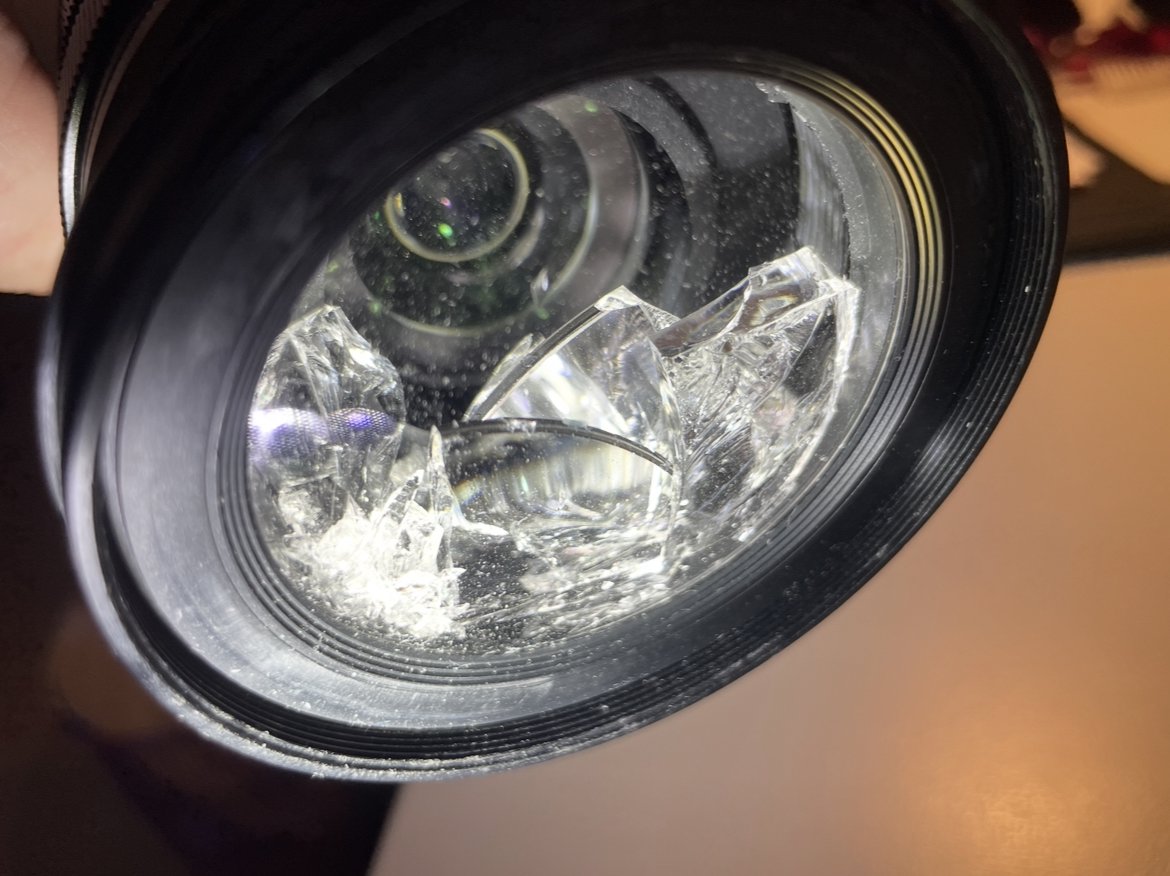
I’m doing research every day. I get information and things are emailed to me. A few days ago, I received an email with a photo of a damaged 12-100 (cover photo), which was subsequently repaired by OMDS. It took them 10 days, including postage, and the sender thought I’d write an article about it – after all, it’s nice to say something positive about the shop for a change.
Right. If I pay the flat-rate fee, the lens gets repaired. Sure, I can write an article about it. But: what exactly is the point? Someone doing what they’re paid to do? When I buy a train ticket, I expect the train to take me to the booked destination at the booked time. If that works out, it’s not a “Wow, that’s brilliant” moment – it’s just what’s expected. I get positive feedback because I a) send my books out quickly and b) pack them so they survive the journey. I’m certainly pleased to receive the feedback – but what does that say about the other senders?
We’ve now reached the point where we’re prepared to accept substandard service at the full price, because, after all, the supplier ‘needs to make a profit’. We’re prepared to accept rubbish journalism, because otherwise the journalist won’t get any more cameras from the manufacturer to review.
We need to rethink things.
A few more facts. A YouTuber who has ‘monetised’ his channel is paid between 1.12 euros and 12 euros per 1,000 views. It depends on what the YouTuber is talking about. The pay is higher for financial services than for simple gaming channels. (Which explains why there are so many finance channels.)
So do I earn two euros per PATLive? No. My channel isn’t monetised.
Why do I do it, then?
Because it means I can have a bit of fun with Rudolf once or twice a month.
Ich wäre nicht hier, wenn Du nicht so wärst wie Du bist. Ich partizipiere von Deinen Fachwissen. Mag ehrlichen Jounalismus. Und Leute die Wort halten. Und ich bin gespannt das Praxisbuch in den händen zu halten.
Volle Zustimmung!
LG
Auch von meiner Seite!
Sehr schöner und fundierter Artikel, mit einem Schlüsselsatz:
“Wenn ich eine Kandidatin interviewe, muss ich auch dem Gegenkandidaten Gelegenheit zur Stellungnahme geben.”
Ich glaube, dass dieser Satz etwas Kontext benötigt. in der Jetztzeit, in der die Glaubwürdigkeit der Medienwelt sich im freien Fall befindet, kommt der Bedeutung des Journalismus mehr Bedeutung zu als je zuvor. Natürlich hat jede “Kandidatin” das Recht, sich frei zu äußern, ebenso sollte Gegenrede Platz finden. Aber die Brisanz dieser Haltung ist dann erkennbar, wenn eine dieser Positionen keine Überprüfbarkeit zulässt, wie sie Karl Popper schon gefordert hat (Falsifikation ecc.). Wenn diese Position Absurditäten ins Feld führt und diese die gleiche Gewichtung in der öffentlichen Darstellung genießt wie eine valide Aussage mit verifizierbarer Authentizität, sprechen wir von False Balance, also falscher Ausgewogenheit.
Ein Beispiel der jüngsten Vergangenheit ist die Berichterstattung in der Coronakrise. Wieviel Schaden das bereitwillig zugestandene Gezeter von Aluhüten, Verschwörungstheoretikern und anderen Gurus angerichtet hat, ist nicht zu ermessen, weder in Übersterblichkeit noch in Kosten.
Ich glaube, dass guter Journalismus nicht in vorauseilender Suche nach demokratischem Gleichgewicht diesen Aspekt aus den Augen verlieren darf; die Verantwortung dieses Berufs muss den Vorwurf des moralischen Filters aushalten können.
Ich war ja seinerzeit im Team “Vorsicht”- weil ich am eigenen Leib gemerkt habe, dass das Zeug keine “harmlose Grippe” war. Und habe eben die Berichterstattung auf allen Ebenen verfolgt. Das große Problem war, dass es zwischen “Aluhüten” und “Systempresse” gefühlt niemanden gab, der noch halbwegs vernünftig berichtet hat. Das ging sogar so weit, dass Drosten sich im NDR-Corona-Update-Podcast in fast jeder Sendung über die Berichterstattung der Mainstreammedien beschwert hat. Weil die eben vor lauter Skandalisierung sagenhaften Dummfug verbreitet haben, was dann natürlich für die “Aluhüte” wieder eine perfekte Zielscheibe war. Dazu kam die offensichtliche Korruption und die Sprüche der Politiker, die zuerst zum Selbernähen von Masken aufriefen und dann die Verwendung dieser Masken unter Strafe stellten – nachdem sie Milliarden Masken eingekauft hatten und so eine Maske – Wert 20 Cent – für bis zu zehn Euro verkauft wurde.
Die Politiker haben die Leute so offensichtlich und so dreist belogen und betrogen – dass ihnen dann auch nicht mehr geglaubt wird, wenn sie mal was Richtiges sagen, wen wundert das?
Das Problem der Interviews mit Vertretern von “seltsamen” Positionen ist ein bildungspolitisches. Wenn ich die Bildung der Bevölkerung auf die drei Themen Fressen, Ficken, Fernsehen beschränke, kann jemand, der erklärt, Hitler sei durch ein geheimes Tor in der Antarktis in die hohle Erde geflohen und habe dort einen geheimen Nazistaat gegründet, die Leute überzeugen. Und dann kann eine EU-Komissarin, die vor versammelter Mannschaft erklärt, die Russen würden ihre Geschirrspüler zerlegen um damit ihre Raketen zu bauen auch noch jahrelang im Amt bleiben, ohne den Aluhut am Bande zu kriegen und postwendend aus dem Amt gelacht zu werden.
Mittlerweile schreiben die “Fact-Checker” genau so viel Mist, wie die Leute, deren “Facts” “gecheckt werden. Blanke Lügen werden überall als Wahrheit verkauft und Leute, die überprüfbare Wahrheiten mitteilen, werden unter Sanktionen gestellt. Und das haben wir nicht nur in der Politik, sondern auch in der Kamerabranche. (Um wieder auf das Thema des Blogs zurückzukommen.)
Wenn wir alle zu Wort kommen lassen würden, würden sich die Idioten mit der Zeit selbst aussortieren weil sie an der Wirklichkeit scheitern.
Ob sich “die Idioten mit der Zeit selbst aussortieren würden” wäre ein spannendes Abenteuer, an dessen Ende die Frage stünde, ob es ein Zurück oder ein Danach dann noch gibt.
Genau mein Gedanke !
lg
Wolfgang
DANKE Reinhard! Vollkommen einverstanden! Dafür schätze ich Dich und dafür liebe ich Deine Beiträge seit jetzt schon über 12 Jahren. Auch, wenn ich mal völlig anderer Meinung als Du bist ;-).