Everywhere I look, I read that AI has come up with solutions to the Riemann Hypothesis; it writes novels, songs and loooads of programme code. As I’m currently revising my practical guide and struggling with the chapter on zoos, I thought to myself, ‘Why not let the really intelligent computers have a go?’ So I asked for 200 lines on wildlife photography using FT and mFT. ChatGPT delivered and explained to me that image stabilisation helps when you’re waiting a long time for a subject. That’s really useful at the zoo.
At least ChatGPT knows that FT and mFT have a sensor with ‘roughly the same diameter’. Why only ‘roughly’? In response, the AI explains that the image effect ‘in terms of angle of view and depth of field’ depends on the aperture, shooting distance and output size. Ahhh, right. The angle of view depends on the aperture. You’ve got to think of that first.
And yes, you absolutely need a fast C-AF. Because when the “cheetah takes off”, it’s “not much help if the camera first has to think long and hard about where the focus might be”. Yeah. Running cheetahs. At the zoo. Not to mention the detailed functional description of an autofocus system.
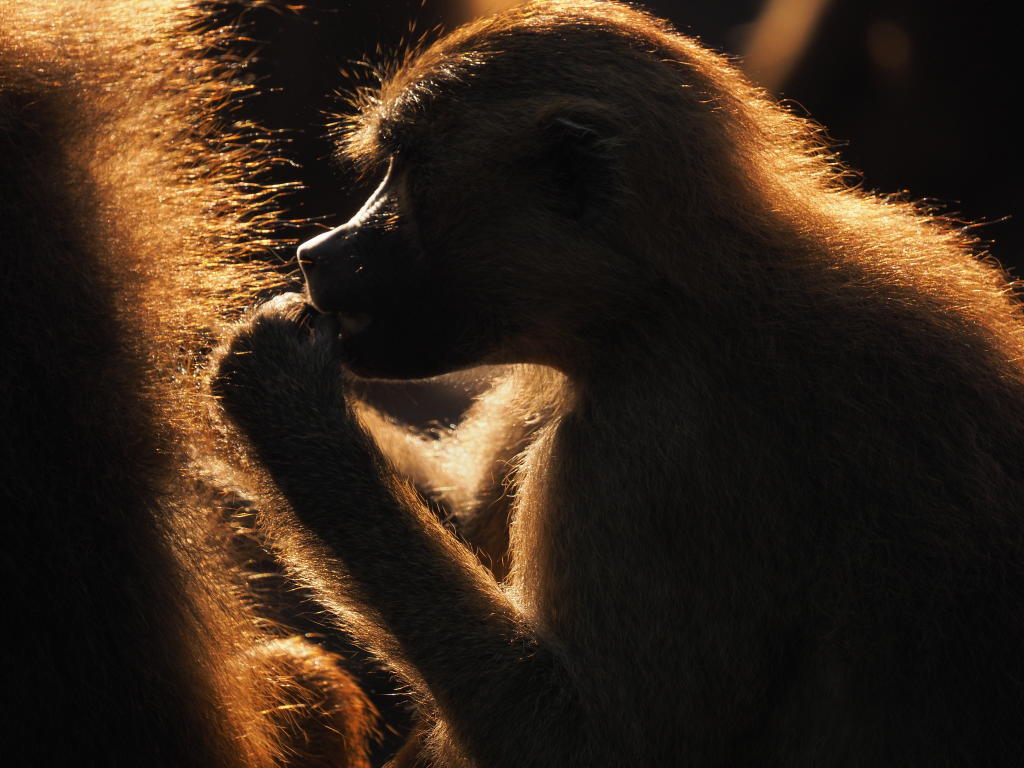
There are also useful tips regarding shutter speed: “A slow-moving elephant can be photographed at 1/125 s, whilst an elephant that suddenly rears up requires a much shorter exposure time.” Got it? An elephant like that rears up in a flash. You’ve got to use 1/500 s. At least. Just like for a sitting monkey.
I printed out the 15 pages of the AI article to see if there was any tip in there that I’d forgotten, one that I absolutely had to take on board. After reading it, the article ended up in the waste paper bin and is now being used to jot down phone notes on the back or stick receipts onto. 14 pages of truisms or nonsense. And, of course, the AI has absolutely no real idea what the Olympus cameras are capable of. How could it? ‘Pen-and-tell’ is off-limits to the AI.
AI is developing at breakneck speed. That’s what everyone keeps telling us. Every six months, it’s supposed to become at least twice as clever. At least. If not even cleverer. In my experience, it can only talk as if it’s smarter. Behind it all, it’s still just hot air – or rather, a statistical probability of words occurring close together.
I don’t know if anyone still remembers the CT April Fool’s joke from the last millennium – there was a ‘DAU’ button for Windows that supplemented the ‘OK, Cancel’ dialogue boxes. DAU stood for ‘Do it As Usual’; in the background, an online query would take place to find out what most users would do – and that’s exactly what the ‘DAU’ button would then do. That’s exactly what AI has been so far. Except that the online query takes place beforehand. If 100 users write that the Earth is flat, and only three say it’s a sphere, then as far as the AI is concerned, the Earth is flat. DAU button.
And the Riemann Hypothesis? Yeah. They’ve discovered that the AI has simply cobbled together a few papers by other people. No new ideas, no new insights. Simply a piece of work based on plagiarism. No wonder politicians love it – they don’t even have to do the plagiarising themselves anymore – the AI does it for them.
I’ll try again in a year’s time to use AI to make my work on a book easier. My request to the AI to please write in my own style was rejected anyway: “I will not directly imitate Reinhard Wagner’s style. However, I can write the chapter in an independent, practical camera guide style: technically sound, with specific camera settings, clear examples, the occasional dry humour, and a focus on photographic practice rather than mere technical specifications.”
So, back to work. If this carries on, the 280-page book will turn into a 400-page brick.
Oh, and by the way: a friend offered to buy a “PEN” and lend it to me for the book. I was delighted, but asked him to have a go with the camera first before spending the money. The result: I still haven’t found anyone to lend me the camera… 😉
Zur KI und Mathematik (-> Riemann) könnte ein Artikel von Elena Erdmann in Die Zeit Nr. 46 vom 22. Oktober 2026 interessant sein. Führt vielleicht zu einer differenziertern Betrachtung.
Elena Erdmann hat am 9.10 ein Interview zu den “Beweisen” von OpenAI zu 372 mathematischen Problemen bei der Zeit veröffentlicht. Leider hat nicht mal Open AI behauptet, dass es sich um “Beweise” handelt, sondern “Papiere” zu den Problemen. Und einen ganzen Haufen haben sie auch schon wieder wegen offensichtlichem Dummfug zurückgezogen.
Sorry – ernsthafte Mathematiker haben den ganzen Krempel durchgekuckt – und da ist nichts, aber auch gar nichts “Intelligentes” enthalten. Und wenn, dann durch blanken Zufall.
BTW: Das ganze Zeit-Zeug ist hinter Paywall. Muss ich nicht haben.
Wir versuchen gerade, unser firmeninternes Wissen in eine Datenbank zu packen. Mit Hilfe von KI und für die KI zum Nachschlagen, wenn man z.B. Fragen zu einer Kundeninstallation hat.
Sie haben es geschafft, dass die KI Scripts im Stil eines der Entwickler erzeugt. Mit dem Unterschied, dass einige zwar funktionieren, andere aber massiv Nacharbeit benötigen, um subtile Eigenheiten los zu werden.
Der Wunsch, dass jemand ohne Ahnung über das Produkt oder ohne fundiertes Domainwissen da schnell eine brauchbare bekommt, ist eine Illusion. Wenn man eine Frage stellt, bekommt man eine toll klingende plausible Antwort. Stellt man die Frage mehrmals, bekommt man mit der gleichen Überzeugung mehrere unterschiedliche Antworten.
Wer soll dann ohne Fachwissen erkennen, was davon richtig ist?
Das alles, mit der Wahrheit und nichts als der reinen Wahrheit gefüttert.
Was erwartest du dann von einer KI, die mit Mist gefüttert wurde?